Due to restoration work, the Mercury Loggia will be closed on Wednesday 8/19 and Thursday 8/20.

Bill Cullina Wins the Edgar T. Wherry Award from NARGS www.morrisarboretum.org/blog/bill-cullina-wins-edgar-t-wherry-award-nargs

… Bill Cullina Wins the Edgar T. Wherry Award from NARGS Executive Director of Morris Arboretum & Gardens Bill Cullina has won the Edgar T. Wherry Award from the North American Rock Garden Society. Bill Cullina, executive director of Morris Arboretum & Gardens, has won the Edgar T. Wherry Award from the North American Rock Garden Society. He received the award for outstanding contributions in the dissemination of information about native North American plants. Image “This is a really thoughtful and appreciated award, given that Wherry was such an important scientist and botanist here for many years,” Cullina said. Wherry (1885–1982) taught botany at the University of Pennsylvania from 1930 to 1955, and had a deep interest in ferns. Many of the botanical specimens Wherry collected are preserved at the Morris and at the Academy of Natural Sciences of Drexel University. Below is an excerpt of the writeup about Cullina that was published in the summer issue of NARGS Quarterly: Bill was previously CEO and before that director of horticulture/plant curator for The Coastal Maine Botanical … Bill Cullina Wins the Edgar T. Wherry Award from NARGS …


Groundbreaking in 2025 for New Garden Railway Train Shed www.morrisarboretum.org/blog/groundbreaking-2025-new-garden-railway-train-shed

… train station. The Garden Railway will have a new look in spring 2025—the nearby train shed “tent” will be replaced with a structure featuring a playful design inspired by the landmark Chestnut Hill West Station newsstand on Germantown Avenue, complete with crooked fascia. The new train shed will provide more space, storage, and better shelter to trainmasters Bruce Morrell and his grandson, Josh Faia, and the staff and volunteers who help keep the trains running. Executive Director Bill Cullina says it will enhance the guest experience, increase accessibility, and celebrate the past while embracing the future. Image The landmark Chestnut Hill West Station newsstand on Germantown Avenue is the inspiration for the new Garden Railway train shed.  “It’s a really cool project because it solves a functional need of replacing the old canvas tent that’s there now,” said Cullina. “It’s also a celebration of the history of trains and Chestnut Hill, and how trains were so formative to the development of Chestnut Hill and the community.” Cullina said while it’s not a scale replica of the newsstand, it will have the same Victorian details—the green, tan, and red paint scheme, and the iconic and charming crooked roofline. There will be an enclosed space outfitted with benchtops, lighting, and shelving to store the extra trains and equipment. An L-shaped 8-foot-deep porch with seating will provide visitors with shelter from the weather and a great spot to watch the goings-on in the garden. Image The current tent shelters the …

Poppy Profusion: A Sculptural Surprise is Back at the Morris www.morrisarboretum.org/blog/giant-poppies

… —Miller brought his signature sense of playfulness and conceptual depth to the Morris for its visitors to marvel at and enjoy.   Image Gary G. Miller standing with his poppies in spring 2008 in front of the Pumphouse at Morris Arboretum & Gardens.  For this year's Bees, Butterflies & Blooms: A Pollinator Paradise exhibition, we are reimagining these giant poppies, bringing them back to delight a new generation of visitors. Designed and installed by the Morris's Executive Director Bill Cullina, these towering blooms pay homage to Gary’s wonderful creative vision while celebrating the vibrant beauty of nature and the crucial role pollinators play in our ecosystem. On view at the Morris through September 30, 2025. Image Morris Executive Director Bill Cullina's reimagination of the poppies, designed and installed in spring 2025. Blog Image July 10, 2025 …

Why Trees Are Losing Leaves & What We Can Do To Help www.morrisarboretum.org/blog/why-trees-are-losing-leaves-what-we-can-do-help

… We Can Do To Help Maybe you've noticed that some trees in your neighborhood are losing leaves at an alarming rate, as if it's the second week of October instead of August.  Maybe you've noticed that some trees in your neighborhood are losing leaves at an alarming rate, as if it's the second week of October instead of August. That's because they are going dormant to conserve energy during the heatwave and drought we're experiencing in Philadelphia. Morris Arboretum's Executive Director Bill Cullina and Director of Horticulture Vince Marrocco spoke with  The Philadelphia Inquirer ,  Fox 29 , and  KWY  to explain what's causing this leaf drop so early in the season, and what we can do to help keep our trees hydrated.  Another heat wave gets underway in Philly, and trees are losing their leaves too soon   - The Philadelphia Inquirer Blog Image August 9, 2022 …

Scarecrows Give Off That 1990s Vibe www.morrisarboretum.org/blog/scarecrows-give-1990s-vibe

… jewelry and customs grills. Image Image Some artists took a more spine-chilling approach. Two of the most shocking are a downright ghoulish Madonna and a thoroughly frightening Beanie Baby bear. Image Image All in all, it is a great display and my hat is off to all the creators who contributed their time and talent to make this trip down memory lane (or, in some cases, alley!) such a success. Come and enjoy the scarecrows, along with our new Morris Pumpkin Cottage, this October! Bill Cullina, F. Otto Haas Executive Director Bill Cullina Blog Image October 2, 2023 …

Thinking Ahead of Climate Change www.morrisarboretum.org/blog/thinking-ahead-climate-change

… up much earlier than usual. Daffodils, red buds, and even cherry blossoms are beginning to bloom with this year's warm winter weather. Last week, Billy Penn at WHYY published the piece, " Flowers and trees are blooming super early in Philly after a warmer-than-usual winter ," featuring Vince Marrocco, Director of Horticulture at the Morris Arboretum. “It’s normal February activity — if you live in South Carolina,” says Vince in the piece.  Image A newly planted Compton oak. Credit: Bill Cullina,  F. Otto Haas Executive Director While the warmer winters in Philadelphia may not be normal in 2023, it could be normalized sooner than we think, and the Arboretum has been actively thinking ahead of climate change for over a decade.  Just this week we planted a Compton oak ( Quercus x Comptoniae ), a hybrid between live oak ( Q. virginiana ) and overcup oak ( Q. lyrata ), which was collected as an acorn on a Southeast VA trip by the Morris Arboretum and Arnold Arboretum in October … overcup oak tolerates wet, compacted soils and live oak tolerates dry soils. "When the Arboretum collects new plants to grow, the quest now reaches to the Carolinas and Georgia – even as far south as Texas. 'Those are areas you wouldn’t traditionally think are home to suitable plants for the Mid-Atlantic area, but temperatures are changing and the plants that want to grow here are changing,' Marrocco said." - Billy Penn at WHYY. Image Live oaks destined for Longwood Gardens. Credit: Bill Cullina,  F. Otto Haas Executive Director   The Arboretum also grew about fifty live oak seedlings from the same 2012 trip. They were transplanted to our field nursery in 2015 and evaluated for growth form and winter hardiness. Some of these live oaks suffered winter dieback, but we kept three and transplanted them to either side of the intersection of Northwestern Avenue and Stenton Avenue. Fifteen additional live oaks were dug from our nursery and shared with the Penn Campus Arboretum, …

#90YearsofMorris: Rose Garden Reopening & History www.morrisarboretum.org/blog/90yearsofmorris-rose-garden-reopening-history

… this much beloved garden.  There has been much to celebrate at the Morris Arboretum & Gardens during our 90th year of being open to the public. Last week, we invited our members to a Member Preview Night that included a ribbon cutting of our newly renovated Rose Garden; a preview of our newest exhibit, Exuberant Blooms : A Pop-Up Garden;  and an after-hours stroll through our gardens while enjoying Weckerly’s ice cream.  The evening began at the top of the Rose Garden with remarks by Bill Cullina, F. Otto Haas Executive Director of the Morris, followed by a ribbon cutting to mark the official reopening of the beloved garden. See images from Member Preview Night at the bottom of this page. In late 2022, ground was broken when the Rose Garden’s bluestone walkway project began. Permeable bluestone hardscaping was installed, greatly enhancing the appearance and accessibility of our iconic garden. There is also a flat accessible entrance, which supports our new electric scooters … pieced back together, and a replica of the original was created. Today, it once again graces a quadrant of the Rose Garden. Interested in joining us for future member-exclusive events? Become a member today ! Member Preview Night: Exuberant Blooms Image Registration table at Member Preview Night. Photo: Eddy Marenco. Image Registration table at Member Preview Night. Photo: Eddy Marenco. Image Morris Arboretum & Gardens backpacks were given to Premier members. Photo: Eddy Marenco. Image Bill Cullina, F. Otto Haas Executive Director of the Morris, giving remarks before the Rose Garden ribbon cutting.  Photo: Eddy Marenco. Image The new paved pathway in the Rose Garden. Mobility scooters are now available to check out at the Widener Welcome Center. Photo: Eddy Marenco. Image L to R: Trevor Schulte, Azalea Meadow Horticulturist; Bill Cullina, F. Otto Haas Executive Director; Vince Marrocco, Gayle E. Maloney Director of Horticulture; Erin Conley, Rosarian .  Photo: Eddy Marenco. Image Members enjoying the newly renovated Rose Garden. Photo: Eddy Marenco. Image Members previewing our new exhibit, Exuberant Blooms, before it opened to the public. Photo: Eddy Marenco. Image Weckerly's provided ice cream sandwiches and popsicles for members to enjoy while strolling through the gardens. Photo: Eddy Marenco. Image A family …

Events

Image
A black and white photograph of a closeup of ferns.

The Roots of American Botany: Vignettes from Philadelphia’s Scientific Past

Thursday, April 23
10:30 am
Virtual
Registration is required
REGISTER

Philadelphia is not only the birthplace of America; it is the birthplace of American botany. Widely celebrated as “America’s Garden Capital,” the city has also played a pivotal role in shaping the nation’s understanding of plant sciences. Join us for a lively virtual discussion exploring Philadelphia’s rich botanical legacy through compelling stories of the past and examples of cutting-edge research tools Morris Arboretum & Gardens scientists as well as other members of the Penn research community are using to solve enduring botanical mysteries. Highlights include new research initiatives at Morris, an exploration of the genetics of Penn’s historic Penn Treaty Elm, and collaborative work in plant genetics with the Penn Museum. Free with registration.

Meet the Participants

Image
A headshot of a man with gray hair smiling outdoors in a suit.
Host
William Cullina
F. Otto Haas Executive Director, Morris Arboretum & Gardens

Prior to joining the Morris, William Cullina was the president and CEO of Coastal Maine Botanical Gardens for 8 years. He holds degrees in plant science and psychology and has been working in public horticulture for 30 years. He has extensive experience in commercial nursery production as well as a background in horticultural and forestry research. Cullina is a well-known author and a recognized authority on North American native plants.

Image
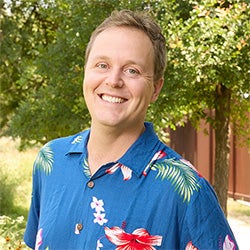
A headshot of a smiling man outdoors with blonde hair and a blue Hawaiian shirt.
Moderator
Dr. Morgan Gostel
John J. Willaman Director of Plant Science, Morris Arboretum & Gardens

Dr. Morgan Gostel is the John J. Willaman Director of Plant Science at the Morris Arboretum & Gardens of the University of Pennsylvania. His research in plant systematics emphasizes diversity and evolution of what he refers to as his botanical A, B, Cs, namely three families of flowering plants including Araliaceae (ginseng and ivy), Burseraceae (frankincense and myrrh), and Compositae (daisies and sunflowers). His work has especially been focused in tropical Africa and Madagascar, but the plants in these families are distributed worldwide. Dr. Gostel is also a Research Associate in the Department of Botany at the Smithsonian Institution’s National Museum of Natural History and the Botanical Research Institute of Texas at the Fort Worth Botanic Garden. Since 2015, he has led the Global Genome Initiative for Gardens (GGI-Gardens), an international partnership of botanic gardens dedicated to supporting the collection of genome-quality tissues from living collections to support genomics research.
 

Image
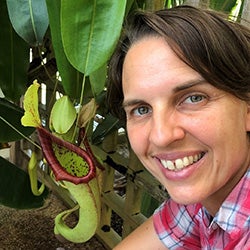
A head shot of a woman smiling and posed near a plant.
Panelist
Dr. Cynthia Skema
Botanical Scientist, Morris Arboretum & Gardens

Cynthia Skema is a Botanical Scientist at Morris Arboretum & Gardens of the University of Pennsylvania. She earned her Ph.D. at Cornell University, an M.Sc. at the Royal Botanic Garden Edinburgh, and a B.A. at Bryn Mawr College. Dr. Skema enjoys studying plants in the field, herbarium, and lab, and she is particularly interested in how DNA evidence can be used to solve puzzles about the evolution, relationships, and demographic history of plants.

Image
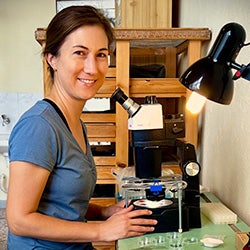
A headshot of a women with dark hair and a blue t-shirt in a laboratory smiling at the camera and sitting in front of a microscope.
Panelist
Dr. Chantel White
Archaeobotanical Teaching Specialist, Center for the Analysis of Archaeological Materials, Penn Museum

Chantel White is the Teaching Specialist for Archaeobotany in the Center for the Analysis of Archaeological Materials (CAAM) at the Penn Museum. She is also a Senior Lecturer in the Department of Anthropology in the School of Arts and Sciences. Her research focuses on the study of plant remains from the Near East, Mediterranean, and historical North America across a diverse set of archaeological sites ranging from the Upper Paleolithic (40,000 years ago) to the recent past (19th century). The shared goal of these studies is the reconstruction of everyday life, particularly the identification of activities related to the storage, preparation, and consumption of foods.

Image
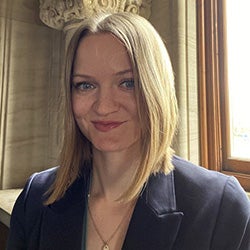
A headshot of a blonde woman smiling at the camera wearing a navy blazer.
Panelist
Dr. Hannah Anderson
Assistant Professor of History at the University of Arkansas at Little Rock

Hannah Anderson is an Assistant Professor of History at the University of Arkansas at Little Rock. Previously, she was the University College Fellow of Early American History at the University of Toronto. She holds a Ph.D. from the University of Pennsylvania. Her book manuscript, Lived Botany: Settlers and Natural History in the Early British Atlantic, examines how settlers exchanged botanical knowledge with Indigenous and African people and argues that these interactions shaped the development of the science of natural history and the fate of England’s Atlantic empire. Dr. Anderson’s work has been supported by many institutions. Most recently, she was a Dibner Long-Term Research Fellow in the History of Science and Technology at the Huntington Library. In the past, she has also received support from the McNeil Center for Early American Studies, the American Philosophical Society, the Consortium for the History of Science, Technology, and Medicine, the John Carter Brown Library, the American Antiquarian Society, the Library Company of Philadelphia, and the New England Regional Fellowship Consortium.

Image
Headshot of a woman with shoulder-length dark hair and hoop earrings.
Host
Alexandra (Lexa) Edsall, GCP’16, GCP’17
Chair, Board of Advisors, Morris Arboretum & Gardens

Since joining the Morris’s Board of Advisors in 2020, Lexa Edsall has been an active member of the Morris’s Master Planning Working Group. Edsall has a deep career in politics and law, serving in the offices of the deputy attorney general and the solicitor general at the US Department of Justice; as an associate at Covington & Burling; as a judicial clerk to Supreme Court Justice Ruth Bader Ginsburg; and as senior adviser to the general counsel at the US Department of the Treasury. Edsall earned her BA and law degree from Harvard University and has a master of city planning degree from the University of Pennsylvania’s Stuart Weitzman School of Design.

Image
A bright green and navy logo that reads, "People, Plants & Penn Discussion Series, Morris Arboretum & Gardens of the University of the Pennsylvania."